





Golub Capital Board Fellows Program

Matching Graduate Students with Philadelphia’s Nonprofit Organizations

Students with prior or no prior nonprofit board experience are eligible to apply for the Golub Capital Board Fellowship.

The experience of Golub Capital Board Fellows is rooted in the program’s commitment to serving nonprofit organizations in the Philadelphia area, and upon selection board fellows enter into an experiential learning environment unlike any other at the University. The fellowship combines nonprofit service with personal development and membership in a community of like-minded peers.

We expect each fellow to uphold 3 equally important pillars of the program:

  1. Participate positively with their partner board and organization;
  2. Contribute actively to the wider board fellows community; and
  3. Engage purposefully in personal leadership development.

The ideal fellowship experience is one that creates mutual benefit for the nonprofit organization, the students, and the wider board fellows community.

Hear from Program Alumni

Sadaf Kazmi, GCBF Class of '06

In 2004, Sadaf Kazmi arrived at the University of Pennsylvania with an ambitious plan: to pursue degrees simultaneously from the Wharton School and Penn Law – a path she forged before a formal dual degree program even existed. A former technology consultant and nonprofit executive, Kazmi came to campus with a mission shaped by personal and professional experience.

Growing up in the Boston area to Pakistani immigrant parents, Kazmi was raised in a family that placed a high value on education — especially in the sciences. Her father strongly encouraged her to become a doctor, while her mother urged her to do something meaningful in the world. As a teenager, Kazmi and her family took bus trips to Washington, D.C., to protest the Gulf War and the Bosnian genocide. That early exposure to activism and global issues deeply influenced her.

She studied math and engineering at the University of Pennsylvania, then spent seven years working as a technology consultant. But in the wake of the Sept. 11 attacks — when immigrants faced heightened scrutiny and legal challenges — Kazmi switched gears. She became the executive director of a small nonprofit group in Boston dedicated to protecting immigrants’ civil rights.

Kazmi hoped to expand the organization to reach more immigrants and make a bigger impact, but she ran into significant hurdles. While the nonprofit’s board was committed to the mission, she said it lacked the governance experience and business acumen needed to support growth. “As an executive director, especially one early in my career, I found this incredibly challenging,” she said.

The nonprofit struggled and ultimately shut down while Kazmi was in graduate school. Surrounded by what she described as a “smart, diverse and talented student body,” she was struck with an idea: What if Wharton students could help nonprofits — who often lack financial expertise — make an impact in the Philadelphia community?  “I saw an opportunity to tap into the Wharton brain trust to help nonprofits like the one I had worked for to address some of the challenges that I experienced with my own board of directors,” she said.

Kazmi soon found a like-minded student in second-year Erica Hamilton ’05, who had independently been thinking about how to connect MBA students with nonprofits. They teamed up to launch a student-run program that would place Wharton students on local nonprofit boards, giving them hands-on governance experience while helping community organizations strengthen their operations.

“My hope was that the program would build a cohort of Wharton students who were dedicated to bettering their communities, help them develop as muti-faceted leaders and inspire a lifetime of service,” Kazmi said.

Early on, they ran into a few snags. They initially partnered with an outside organization to help recruit nonprofit partners and provide basic governance training for MBA students. But the arrangement didn’t work as they had planned. Shortly after launching The Wharton Nonprofit Board Leadership Program, Hamilton graduated and Kazmi assembled a student-led board of directors to oversee the initiative instead.

“The reality was, there was so much intellectual horsepower inside the university,” she recalled. “If I wanted to run a training program on a particular area of finance, it didn’t really make sense to use this outside organization when Wharton has the best finance department in the world.”

The following summer, Kazmi stayed in Philadelphia for an internship and spent time knocking on doors and tapping into her network of largely Wharton alumni in search of nonprofit partners for her student-run program. The response was enthusiastic: 30 organizations committed to hosting a Wharton student on their board.

Kazmi accepted only 10 MBA students in each of the first two years to ensure the fellows had a wide range of nonprofit partners to choose from and with a cause they were passionate about. Eventually, Wharton increased the number of fellows, driven partly by growing student demand and by nonprofits that had gone unmatched and were reconsidering their participation.

Kazmi did not serve on a board herself so she could focus on managing the program. She recruited Wharton faculty to help train the fellows in nonprofit governance, finance and leadership.

Two years after the student group started, Lynn Perry Wooten of the Wharton Leadership Program reached out to Kazmi with unexpected news: Incoming students were expressing excitement about the nonprofit board initiative even before setting foot on campus. And Wharton wanted to formally adopt the student-run effort as an institutionally supported program — a move that thrilled Kazmi.

“I didn’t want the organization to die with my graduation,” she said. With the school’s backing, long-term relationships with nonprofits could be preserved, and institutional knowledge about what worked — and what didn’t — could ensure the program’s longevity.

Since its inception, the student organization – now called the Golub Capital Nonprofit Board Fellows program– has evolved significantly. Today, hundreds of graduate students apply for more than 54 spots.  Students from both Wharton and Penn Law are placed in pairs with a nonprofit in the Philadelphia community and serve as non-voting board members. Each team of fellows completes a strategic project for their organization.

Now Head of Global Creator Products & Global Expansion Product at Audible, Kazmi often uses skills honed in creating Wharton’s nonprofit board program. She recalls the pivots and collaborations required to create the student group and sees direct parallels with her work today. “That idea of iteration is something that I use all the time,” she said. “We constantly ask: Are we meeting the needs of the customer? Can we be doing this better, more efficiently, more effectively?”

Kazmi is also committed to staying involved in social impact work. She has served on the board of the Science Club for Girls and now sits on the nominating committee of a local Girl Scout Council.

Twenty years after starting the student-run group at Wharton, Kazmi is heartened by the program’s growth and soaring popularity. “These MBA students are business leaders who want to give back right now, spending their free time when they’re super busy on something that makes a difference and has a social impact mission. It makes me feel good about humanity.”

Ted Baumgardner, GCBF Class of 23'

Ted Baumgardner, JD/MBA ’24, has navigated both Navy decks and construction sites – first as a Marine Corps intelligence officer and later as a glazing estimator in the building industry. From the Mediterranean Sea to Okinawa, Japan, his military career demanded fast-paced data collection and precise organization — skills he later carried into civilian life in Philadelphia.

Both roles, though worlds apart, converged in 2023 when Baumgardner launched Guthrie AI, a business that uses artificial intelligence to help construction companies organize jobs, manage requests for bids and create proposals.

“What I do at Guthrie AI is similar to when I was an intelligence officer in the Marine Corps,” he said. “We would use different platforms to collect and synthesize all this data for our commander so he could take action.”

Baumgardner grew up in South Jersey in a family steeped in the building trades. His father runs a general contracting company, and his mother founded a glass and glazing company, where Baumgardner and his three brothers have all worked. He was in fifth grade when the Sept. 11 attacks occurred – events that left a deep impact and inspired his goal of serving in the military. That goal led him to the U.S. Naval Academy, where he earned a bachelor’s degree in quantitative economics.

After graduating, Baumgardner served eight years in the Marines during a period of relative peace. Much of his deployment was spent aboard Navy ships in the Mediterranean, the Suez Canal and the Arabian Gulf, working alongside fellow Marines to build relationships with partner forces. He spent his final three years stationed in Japan.

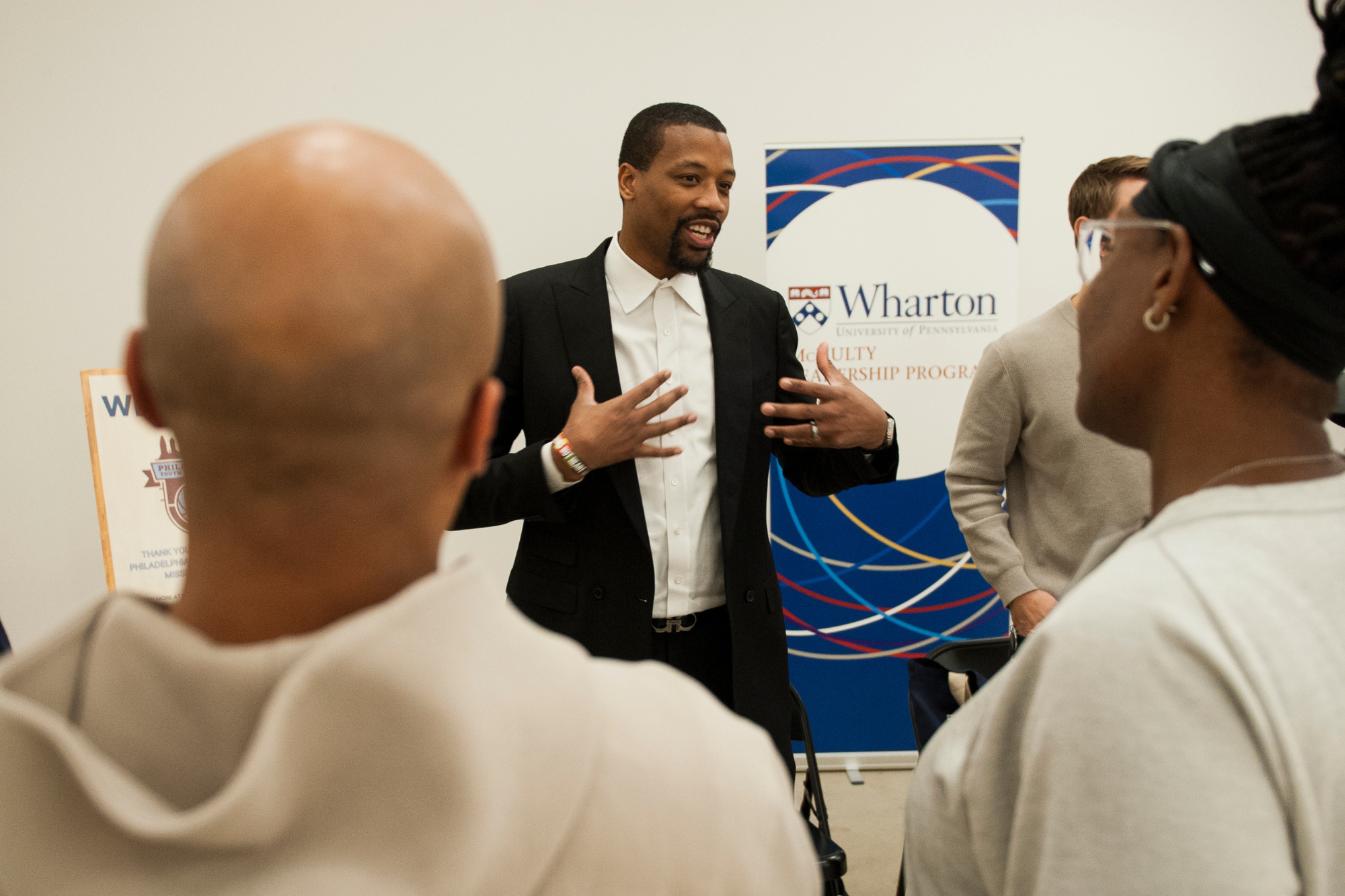
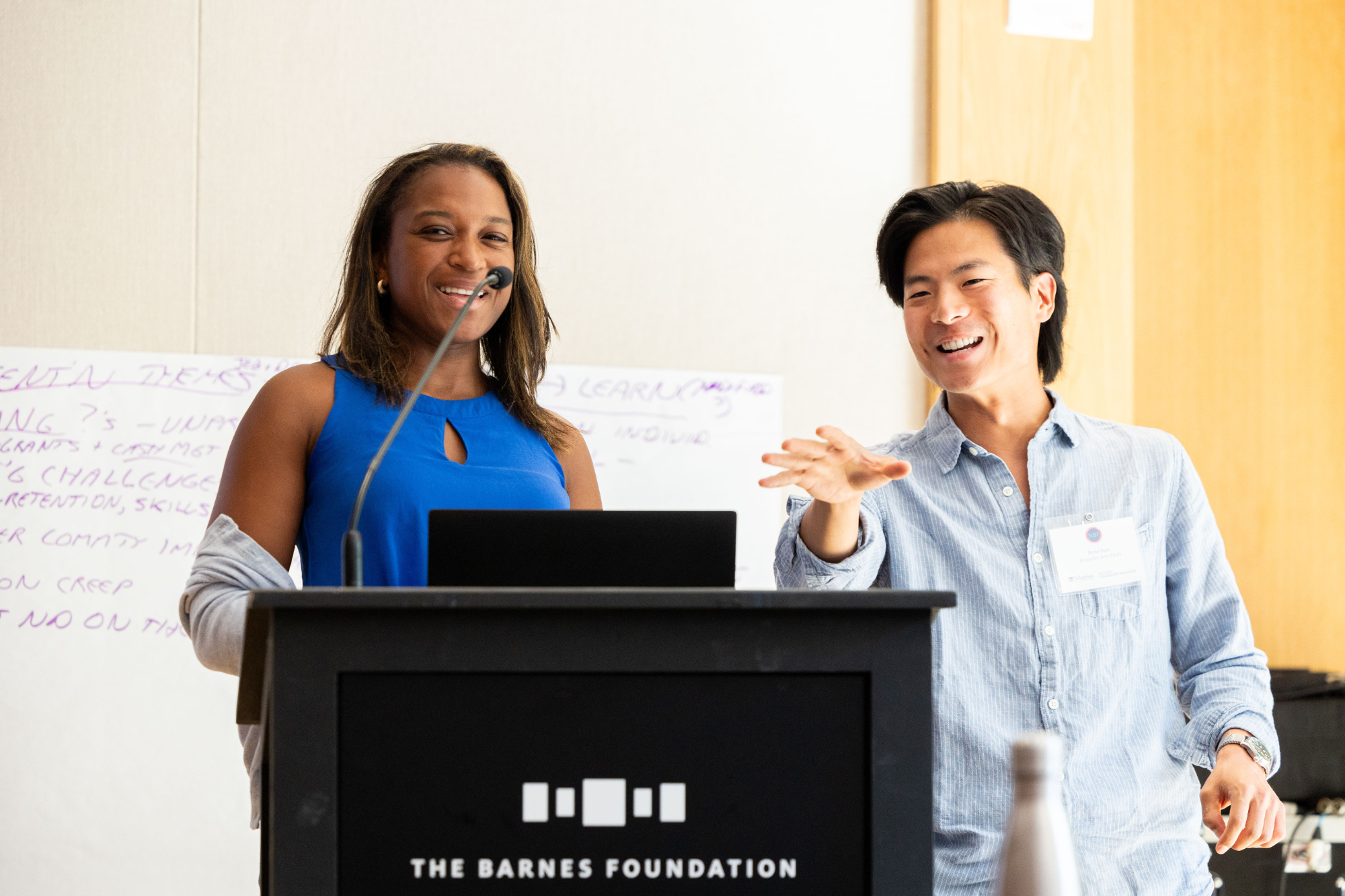
Ted Baumgardner, Alumnus of the GCBF Program Class of 2023 talking to Fellows at our Fall Retreat about his experience on Beyond Literacy's Board following his service as a Fellow.
Ted Baumgardner, GCBF Program Class of 2023 talking to Fellows at our Fall Retreat about his experience on Beyond Literacy’s Board following his service as a Fellow.

After leaving the Marines, Baumgardner returned to civilian life by enrolling in a dual JD/MBA degree at the University of Pennsylvania. Raised by two entrepreneurial parents, Baumgardner always knew he wanted to go into business. At the same time, he’d observed the litigious nature of the construction industry with both perplexity and curiosity – an experience that sparked his interest in law.

“Getting my MBA was something I knew I wanted to do,” he said. “When I found out that Penn had this incredible joint program with an interdisciplinary opportunity, it immediately appealed to me.”

During graduate school, Baumgardner worked as an estimator for his mother’s glass and glazing business. He noticed that advances in technology were producing an overwhelming volume of data — much of it confusing — for installers on job sites.

“That led me to try out different ideas to create a service for installers that could manage some of the documentation, organization and synthesis,” he said. “One of the best things about graduate school is it provided an opportunity for me to experiment and explore.”

At the same time he was testing his business ideas, he was accepted into the Golub Capital Board Fellows Program, which matches Wharton and Penn Law students to serve on the boards of nonprofit organizations in Philadelphia.

“The fellowship became one of the defining elements of my experience at Penn, because it gave me the opportunity to apply classroom lessons in a totally different environment: with a functioning board,” he said. “In addition, I was grateful that it connected me to the community of Philadelphia.”

Baumgardner was partnered with Beyond Literacy, a nonprofit offering adult education in reading, writing, math, English as a second language and digital literacy. The organization was formed in 2021 through the merger of two local nonprofits. In the wake of the consolidation, Beyond Literacy’s budget quadrupled to $6.6 million, and its staff grew threefold to 78.

“Because he joined us at such a pivotal moment, he worked with board attorneys to review our governance documents,” said Kimmell Proctor, CEO of Beyond Literacy.

First, he put together an onboarding packet for board members that laid out their legal duties and responsibilities. “He took that and built it out to be hosted online and made it a much more accessible and robust resource for new board members,” she said.

Next, Proctor asked him to evaluate options for switching the organization’s human resources provider to a professional employer organization, or PEO, to relieve administrative burden on staff. He completed the due diligence and presented his recommendation to the board. “One of the things he was able to bring to light was that the value of PEOs declines the larger the agency grows,” Proctor noted.

Beyond Literacy ended up hiring a company that Proctor had worked with before that fit better with the growth trajectory of the nonprofit. It was not the company that he had recommended — a decision that taught Baumgardner a difficult lesson in leadership.

“That was helpful for me to reframe what my contribution was to this organization,” he recalled. “My role wasn’t necessarily making the decisions; it was providing support and guidance to the folks in the trenches, who have more information than me about the nonprofit and its needs.

“Kimmell had more context and seasoned judgement than I had,” he added.

Baumgardner played a key role in launching the nonprofit’s Young Friends Advisory Group, a subcommittee of the board that’s a pipeline for volunteers and potential board members. “It’s been fantastic because we now have more young professionals — particularly from Penn — helping us and working directly with our learners,” Proctor said.

By the time he completed his MBA, Baumgardner had launched Guthrie AI, where he often applies learnings from his fellowship.

“Because I’m a service provider to small construction companies, I’m supporting them, not making decisions for them,” he said. “It’s difficult for me because I want to be in the trenches, but it’s a learning I’m pulling from my experience as a board fellow.”

As soon as Baumgardner completed his fellowship, the leadership team of Beyond Literacy asked him to join the board as a full member. Even with one year left in law school, he accepted. He served on the Finance Committee, where he helped ensure the nonprofit’s funding remains robust, even in current times.

“When you have a [nonpartisan] organization like Beyond Literacy that does so much good and doesn’t ask someone’s political affiliation when they provide services — it’s really important to me to make sure it has the resources to continue the mission, regardless of the political climate,” he said.

Baumgardner recently stepped down from the board after three years of service to focus on his growing business and family. Proctor said Baumgardner was an outstanding board member who brought “bold ideas and younger energy to the board.” His background in real estate and construction was especially valuable: When Beyond Literacy’s co-tenant approached the nonprofit about buying a building together and consolidating shared services such as reception, Baumgardner was asked to assess the proposal. The board is weighing the idea.

Proctor lauded Baumgardner for being an engaged board member from both financial and legal perspectives. “He was active on our committee and such a great thought partner to me. “To have any of those things as a board member is important,” she said. “But to be able to have them all in Ted made him a standout member of our board leadership team.”

More Programmatic Information

Role of Visiting Board Member

After being paired and matched with one of our nonprofit partner organizations, fellows take up the role of a nonvoting, visiting board member.  Although “visiting” does not necessarily connote dynamic participation, we expect fully that fellows engage actively with their boards to reflect the experiential nature of the role.  We intend for their experience to be defined by two equally important duties:

  • Visiting Board Members should be continuously learning and developing over the duration of the fellowship;
  • Visiting Board Members should be contributing positively to the work of the board, in a scope determined through mutual agreement with the board.

In contrast with your elected board members, visiting board members cannot engage in two expectations of full board membership.  Namely, they may not:

  • register a vote (i.e., as an elected member votes) on matters relating to the work of the organization, the board, and any board subcommittee; or
  • be expected to make a financial commitment to an organization (i.e., participate in an annual give/get, or be included in board giving statistics).

However, visiting board members will be expected to attend all board meetings, should serve as an active member of a board subcommittee as applicable, and are expected to participate in all board discussions and initiatives as appropriate.

Board Fellow Commitment & Timeline

On average, the Board Fellows commitment is time intensive.  During the first academic year (March-May) of participation, fellows are required to:

  • attend a new class kickoff event
  • attend and actively participate in a two-day training in March
  • attend and actively participate in 4 evening trainings in March and April
  • meet with the staff of their assigned host organization and with the outgoing fellows
  • work with a dyad partner to create a deep dive of their host nonprofit organization
  • meet with staff for a goal setting conversation
  • attend the annual end-of-year partner GCBF Poster Showcase

During the second academic year (September-May), board fellows report dedicating an average range of 15-20 hours per month in these required activities:

  • attending all full board and subcommittee meetings of matched board
  • attending and actively participating in two-day training in September and evening trainings on various nonprofit topics
  • attend GCBF Committee meetings to plan social events, volunteering activities, and alumni engagement
  • meet with staff for check-ins
  • attend the annual end-of-year Project Showcase

Training Topics

In support of their role as visiting board members, Board Fellows are offered a training program that spans their 14-month commitment.  The training topics fall under three umbrellas:

  • the nonprofit sector;
  • nonprofit governance, and
  • leadership development

In the past, specific topics have included:

  • nonprofit sector overview
  • basic roles and responsibilities of nonprofit boards
  • ethical concepts in nonprofit governance
  • scope and depth of philanthropy in the US
  • grants and grantmaking
  • nonprofit finance
  • program measurement & evaluation
  • effective communication
  • team performance
  • organizational assessment
  • group dynamics
  • strategic persuasion

Fellow-Board Matching & Pairing Process

The goal of the match is threefold: to match each board fellow with a board doing work they care about, to pair fellows up using self-reported data, and achieve a combination of matches that is optimal for the entire group.  To achieve all three, we follow this process starting in March each year:

  • Each fellow is given a copy of the matching pack, which includes information about the ~25 organizations that make up our partner pool, other supporting documents, and regulatory fit inventories. Fellows have time to look through the materials, and may request a meeting with staff to discuss interests and objectives.
  • Fellows submit their inventories and a list of organizations in rank order.
  • Staff run the data through an Excel optimization, which simultaneously matches and pairs each fellow within the optimal happiness of the group.
  • Staff fine tunes matches using data collected through the fellowship interview process, resumes, conversations, and inventories.
  • Staff separately informs the organization and board fellow pair of the match; then sends an email of introduction. The pair of fellows manage the relationship (with support as needed) from that point on.
  • Check out the 2025-2026 Fellows and Pairings list.